Dying Earth
-
Excrement produced by chickens, pigs, and other farm animals: 16.6 billion tons per year -- more than a million pounds per second (that's 60 times as much as is produced by the world's human population -- farmed animals produce more waste in one day than the U.S. human population produces in 3 years). This excrement is a major cause of air and water pollution. According to the United Nations: "The livestock sector is... the largest sectoral source of water pollution, contributing to eutrophication, 'dead' zones in coastal areas, degradation of coral reefs, human health problems, emergence of antibiotic resistance and many others."
-
Water used for farmed animals and irrigating feed crops: 240 trillion gallons per year - 7.5 million gallons per second (that's enough for every human to take 8 showers a day, or as much as is used by Europe, Africa, and South America combined). According to the UN: the water used by the sector exceeds 8 percent of the global human water use." As just one example, "On average 990 litres of water are required to produce one litre of milk." So drinking milk instead of tap water requires almost 1,000 times as much water.
-
United Nations scientists, in their 408-page indictment of the meat industry, sum up these statistics, pointing out that the meat industry is "one of the ... most significant contributors to the most serious environmental problems, at every scale from local to global," including "problems of land degradation, climate change and air pollution, water shortage and water pollution, and loss of biodiversity."
The meat industry contributes to land degradation, climate change, air pollution, diseases, water shortage, pollution, and loss of biodiversity.
million pounds of antibiotics used sub-therapeutically in the United States each year. Antibiotics are given to animals for therapeutic reasons, but that use isn't as controversial because few argue that sick animals should not be treated.
The biggest controversy centers around taking antibiotics that are used to treat human illnesses and administering them to food animals. There is an increasing amount of evidence suggesting that the sub-therapeutic use of antibiotics in food animals can pose a health risk to humans. If a group of animals is treated with a certain antibiotic over time, the bacteria living in those animals will become resistant to that drug. According to microbiologist Dr. Glenn Morris, the problem for humans is that if a person ingests the resistant bacteria via improperly cooked meat and becomes ill, he or she may not respond to antibiotic treatment.
Concern about the growing level of drug-resistant bacteria has led to the banning of sub-therapeutic use of antibiotics in meat animals in many countries in the European Union and Canada. In the United States, however, such use is still legal. The World Health Organization is concerned enough about antibiotic resistance to suggest significantly curbing the use of antibiotics in the animals we eat. In a recent report, the WHO declared its intention to "reduce the overuse and misuse of antimicrobials in food animals for the protection of human health." Specifically, the WHO recommended that prescriptions be required for all antibiotics used to treat sick food animals, and urged efforts to "terminate or rapidly phase out antimicrobials for growth promotion if they are used for human treatment."
Although conclusive evidence directly linking the use of drugs in food animals to an increase in drug-resistant bacteria that make people sick has not been uncovered, a number of recent studies suggesting such a link concern many scientists. "There is no evidence that antibiotic resistance is not a problem, but there is insufficient evidence as to how big a problem it is," says Dr. Margaret Mellon, with the Union of Concerned Scientists.
In one study published in the New England Journal of Medicine on February 6, 2002, researchers found links that strongly suggested that the people who developed Cipro-resistant bacteria had acquired them by eating pork that were contaminated with salmonella. The report concluded that salmonella resistant to the antibiotic flouroquine can be spread from swine to humans, and, therefore, the use of flouroquinolones in food animals should be prohibited.
Another New England Journal of Medicine study from Oct. 18, 2001, found that 20 percent of ground meat obtained in supermarkets contained salmonella. Of that 20 percent that was contaminated with salmonella, 84 percent was resistant to at least one form of antibiotic.
CIPRO AND BAYTRIL
Some, including the FDA, believe the overuse of Baytril, an antibiotic used to treat sick birds, led to an increase in treatment-resistant bacterial infections in humans. Baytril is used by poultry growers to protect chickens and turkeys from E. coli infection. The size of commercial chicken flocks precludes testing and treating individual birds, so when a veterinarian diagnoses one infected bird, farmers treat the whole flock by adding the drug to its drinking water. General use of Baytril, therefore, falls in the gray area between therapeutic and sub-therapeutic.
Baytril is the sister drug to Cipro, which is used to treat and prevent anthrax as well as campylobacteriosis and salmonellosis in people. The Food and Drug Administration, doctors, and consumer groups have all urged that Baytril be removed from the market on the grounds that its use in animals may eventually compromise the power of Cipro and similar antibiotics to fight disease in humans. Cipro and Baytril belong to a class of drugs known as fluoroquinolone, among the most powerful antibiotics currently available.
Baytril first came up for approval for use in chickens six years ago. Physicians have used fluoroquinolones to treat food-borne illness since 1986, but fluoroquinolone-resistant bacteria were rare until 1995, when the FDA approved the use of these drugs in drinking water for poultry. The FDA's rough estimate, using 1999 data, is that use of fluoroquinolones in chickens resulted in over 11,000 people that year contracting a strain of the campylobacter illness that was resistant to fluoroquinolones, contributing to unnecessarily severe disease.
When the FDA proposed pulling Baytril use in chickens a year ago due to sharp increases in resistance to fluoroquinolones in campylobacter bacteria, one of the two manufacturers voluntarily withdrew its product. The other, Bayer, did not.
Bayer officials continue to offer the human drug Cipro at reduced rates to the American public, saying that they are not convinced that the use of fluoroquinolones in animals can be blamed for increased resistance in people. Until more proof is found of the specific danger to humans, they will not withdraw their product from the chicken market. -Frontline
Antibiotic


Grazing and land use
Dryland grazing on the Great Plains in Colorado
In comparison with grazing, intensive livestock production requires large quantities of harvested feed. The growing of cereals for feed in turn requires substantial areas of land. However, where grain is fed, less feed is required for meat production. This is due not only to the higher concentration of metabolizable energy in grain than in roughages, but also to the higher ratio of net energy of gain to net energy of maintenance where metabolizable energy intake is higher. A pound of beef (live weight) requires about seven pounds of feed, compared to more than three pounds for a pound of pork and less than two pounds for a pound of chicken. However, assumptions about feed quality are implicit in such generalizations. For example, production of a pound of beef cattle live weight may require between 4 and 5 pounds of feed high in protein and metabolizable energy content, or more than 20 pounds of feed of much lower quality.
Free-range animal production requires land for grazing, which in some places has led to land use change. According to the Food and Agriculture Organization (FAO), "Ranching-induced deforestation is one of the main causes of loss of some unique plant and animal species in the tropical rainforests of Central and South America as well as carbon
Water resources
Virtual water use for livestock production includes water used in producing feed. However, virtual water use data, such as those shown in the table, are often unrelated to environmental impacts of water use. For example, in a high-rainfall area, if similar soil infiltration capacity is maintained across different land uses, mm of groundwater recharge and hence sustainability of water use tends to be about the same for food crop production, meat-yielding livestock production, and saddle horse production, although virtual water use per kg of food produced may be several hundred L, several thousand L, and an infinite number of L, respectively. In contrast, in some low-rainfall areas, some livestock production is more sustainable than food crop production, from a water use standpoint, despite higher virtual water use per kg of food produced. This is because unirrigated land in many water-short areas may support grassland ecosystems in perpetuity, and thus may be able to support well-managed, extensive production of grazing cattle or sheep with a sustainable level of water use, even where large-scale production of more water-demanding food crops would be unsustainable in
Effects on aquatic ecosystems
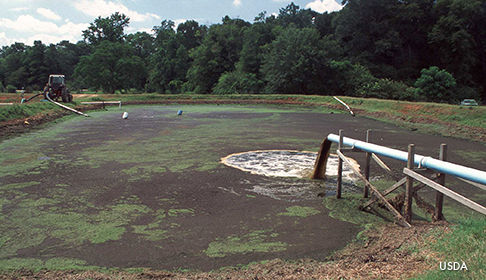
In the Western United States many stream and riparian habitats have been negatively affected by livestock grazing. This has resulted in increased phosphates, nitrates, decreased dissolved oxygen, increased temperature, turbidity, and eutrophication events, and reduced species diversity. Livestock management options for riparian protection include salt and mineral placement, limiting seasonal access, use of alternative water sources, provision of "hardened" stream crossings, herding, and fencing. In theEastern United States waste release from pork farms have also been shown to cause large-scale eutrophication of bodies of water, including the Mississippi River and Atlantic Ocean (Palmquist, et al., 1997). However, in North Carolina, where Palmquist's study was done, measures have since been taken to reduce risk of accidental discharges from manure lagoons; also, since then there is evidence of improved environmental management in US hog production. Implementation of manure and wastewater management planning can help assure low risk of problematic discharge into aquatic systems.
Energy consumption and greenhouse gas emissions
Farmer ploughing rice paddy, inIndonesia. Animals can provide a useful source of draught power to farmers in thedeveloping world
At a global scale, the FAO has recently estimated that livestock (including poultry) accounts for about 14.5 percent of anthropogenic greenhouse gas emissions estimated as 100-year CO2 equivalents. (A previous, widely cited FAO report had estimated 18 percent. Because this emission percentage includes contributions associated with livestock used for production of draft power, eggs, wool and dairy products, the percentage attributable to meat production alone is significantly lower. The indirect effects contributing to this percentage include emissions associated with production of feed consumed by livestock and carbon dioxide emission from deforestation in Central and South America, attributed to livestock production. Mitigation options for reducing methane emission from ruminant enteric fermentation include genetic selection, immunization, rumen defaunation, diet modification and grazing management, among others.The principal mitigation strategies identified for reduction of agricultural nitrous oxide emission are avoiding over-application of nitrogen fertilizers and adopting suitable

release in the atmosphere. This for example has implications for meat consumption in Europe, which imports significant amounts of feed from Brazil.
Raising animals for human consumption accounts for approximately 40% of the total amount of agricultural output in industrialized countries. Grazing occupies 26% of the earth's ice-free terrestrial surface, and feed crop production uses about one third of all arable land.
Land quality decline is sometimes associated with overgrazing. Rangeland health classification reflects soil and site stability, hydrologic function and biotic integrity. By the end of 2002, the US Bureau of Land Management had evaluated rangeland health on 7,437 grazing allotments (i.e. 35 percent of its grazing allotments or 36 percent of the land area contained in its grazing allotments) and found that 16 percent of these failed to meet rangeland health standards due to existing grazing practices or levels of grazing use. This led the BLM to infer that a similar percentage would be obtained when such evaluations were completed. Soil erosion associated with overgrazing is an important issue in many dry regions of the world. However, on US farmland, much less soil erosion is associated with pastureland used for livestock grazing than with land used for production of crops. Sheet and rill erosion is within estimated soil loss tolerance on 95.1 percent, and wind erosion is within estimated soil loss tolerance on 99.4 percent of US pastureland inventoried by the US Natural Resources Conservation Service.
Environmental effects of grazing can be positive or negative, depending on the quality of management, and grazing can have different effects on different soils and different plant communities. Grazing sometimes reduces, but sometimes increases biodiversity of grassland ecosystems. A study comparing virgin grasslands under some grazed and nongrazed management systems in the US indicated somewhat lower soil organic carbon but higher soil nitrogen content with grazing. In contrast, at the High Plains Grasslands Research Station in Wyoming, the top 30 cm of soil contained more organic carbon as well as more nitrogen on grazed pastures than on grasslands where livestock were excluded. Similarly, on previously eroded soil in the Piedmont region of the US, pasture establishment with well-managed grazing of livestock resulted in high rates of both carbon and nitrogen sequestration relative to results obtained where grass was grown without grazing. Such increases in carbon and nitrogen sequestration can help mitigate greenhouse gas emission effects. In some cases, ecosystem productivity may be increased due to grazing effects on nutrient cycling.
Photo by: Jeff Vanugam

the long run due to inadequate surface water supplies and inadequate groundwater recharge to sustain a high level of withdrawn water use for irrigation. Such considerations are important on much rangeland in western North America and elsewhere that can support cow-calf operations, backgrounding of stocker cattle, and sheep flocks. In the US, withdrawn surface water and groundwater use for crop irrigation exceeds that for livestock by about a ratio of 60:1.
Also, the high virtual water use figures associated with meat production do not necessarily imply reduction of water use if food crops are produced, instead of livestock. For example, some grazing lands are unsuitable for food crop production, so that evapotranspirational water use would continue on land vacated by livestock, while additional water would be needed for crops to provide substituting food from lands elsewhere, and additional water would also be needed to produce substitutes for the non-food products of livestock. (In the US, Land Capability Classes V, VI and VII contain soils unsuited for cultivation, much of which is suitable for grazing. Of non-federal land in the US, about 43 percent is classed as unsuitable for cultivation.)
Irrigation accounts for about 37 percent of US withdrawn freshwater use, and groundwater provides about 42 percent of US irrigation water. Irrigation water applied in production of livestock feed and forage has been estimated to account for about 9 percent of withdrawn freshwater use in the United States. Groundwater depletion is a concern in some areas because of sustainability issues (and in some cases, land subsidence and/or saltwater intrusion). A particularly important North American example where depletion is occurring involves the High Plains (Ogallala) Aquifer, which underlies about 174,000 square miles in parts of eight states, and supplies 30 percent of the groundwater withdrawn for irrigation in the US. Some irrigated livestock feed production is not hydrologically sustainable in the long run because of aquifer depletion. However, rainfed agriculture, which cannot deplete its water source, produces much of the livestock feed in North America. Corn (maize) is of particular interest, accounting for about 91.8 percent of the grain fed to US livestock and poultry in 2010 :table 1–75 About 14 percent of US corn-for grain land is irrigated, accounting for about 17 percent of US corn-for-grain production, and about 13 percent of US irrigation water use, but only about 40 percent of US corn grain is fed to US livestock and poultry. :table 1–38 Together, these figures indicate that most production of grain used for US livestock and poultry feed does not deplete water resources and that irrigated production of grain for livestock feed accounts for a small fraction of US irrigation water use. However, where production relies on irrigation from groundwater reserves, water table monitoring is appropriate to provide timely warning if groundwater depletion occurs.

manure management practices. Mitigation strategies for reducing carbon dioxide emissions in the livestock sector include adopting more efficient production practices to reduce agricultural pressure for deforestation (notably in Latin America), reducing fossil fuel consumption, and increasing carbon sequestration in soils.
At a national level, livestock represents up to half of New Zealand's greenhouse gas emissions. Livestock sources (including enteric fermentation and manure) account for about 3.1 percent of US anthropogenic greenhouse gas emissions expressed as carbon dioxide equivalents, according to US EPA figures compiled using UNFCCC methodologies. Not all forms of meat and animal–based foods affect the environment equally. One study estimates that red meats are 150% more greenhouse gas intensive than chicken or fish. According to another research group, the ranking of some food products in relation to greenhouse gas emissions is lamb, beef, cheese and pork. However, such ranking may not be broadly representative. Among sheep production systems, for example, there are very large differences in both energy use and prolificacy; both factors strongly influence emissions per kg of lamb production.
Because a large fraction of GHG emissions attributed to livestock production involves methane (from enteric fermentation and manure management), care is appropriate in considering contributions of these emissions to global warming. Relative to carbon dioxide, atmospheric methane has a 100-year global warming potential of 25 (including indirect effects on ozone and stratospheric water vapor). Methane emission from livestock and other anthropogenic sources has contributed substantially to past warming; however, it is of much less significance for current and recent warming. This is because there has been relatively little increase in atmospheric methane concentration in recent years, with total methane sources, estimated at 582 Tg per year, being nearly balanced by methane sinks, estimated at 581 Tg per year. In a tabulation by the IPCC, estimates of methane emission from global livestock range from 80 to 115 Tg per year.
Data of a USDA study indicate that about 0.9 percent of energy use in the United States is accounted for by raising food-producing livestock and poultry. In this context, energy use includes energy from fossil, nuclear, hydroelectric, biomass, geothermal, technological solar, and wind sources. (It excludes solar energy captured by photosynthesis, used in hay drying, etc.) The estimated energy use in agricultural production includes embodied energy in purchased inputs.
Intensification and other changes in the livestock industries influence energy use, emissions and other environmental effects of meat production. For example, in the US beef production system, practices prevailing in 2007 are estimated to have involved 8.6 percent less fossil fuel use, 16.3 percent less greenhouse gas emissions, 12.1 percent less water use and 33.0 percent less land use, per unit mass of beef produced, than in 1977. These figures are based on analysis taking into account feed production, feedlot practices, forage-based cow-calf operations, backgrounding before cattle enter a feedlot, and production of culled dairy cows.
Ranchers and farmers have been feeding antibiotics to the animals we eat since they discovered decades ago that small doses of antibiotics administered daily would make most animals gain as much as 3 percent more weight than they otherwise would. In an industry where profits are measured in pennies per animal, such weight gain was revolutionary.
Although it is still unclear exactly why feeding small "sub-therapeutic" doses of antibiotics, like tetracycline, to animals makes them gain weight, there is some evidence to indicate that the antibiotics kill the flora that would normally thrive in the animals' intestines, thereby allowing the animals to utilize their food more effectively.
The meat industry doesn't publicize its use of antibiotics, so accurate information on the amount of antibiotics given to food animals is hard to come by. Stuart B. Levy, M.D., who has studied the subject for years, estimates that there are 15-17
European Journal of Clinical Nutrition
EVALUATING THE INVIRONMENTAL IMPACT OF VARIUS
DIETARY PATTERNS COMBINED WITH DIFFRENT FOOD
PRODUCTION SYSTEMS
Congressional Reasearch Service
ANIMAL WASTE AND WATER QUALITY
US Environmental Protection Agency
US ANAEROBIC DIGESTER STATUS REPORT
HOW YOU CAN HELP
• DO NOT BUY meat, cheeze, millk, eggs, or other animals products.
• Go on plant based food! Stop eating animals.
• Ask restaurants to serve more plant based food.
• Ask supermarkets to carry more plant based products.
• Educate others about factory farming.
• Spread the word! Click on the button to share this information with others via email or your favourite social networking service
• Switch from livestock farming to peaceful farming
!
Animal agriculture is a leading consumer of water resources in the United States, Pimentel noted. Grain-fed beef production takes 100,000 liters of water for every kilogram of food. Raising broiler chickens takes 3,500 liters of water to make a kilogram of meat. In comparison, soybean production uses 2,000 liters for kilogram of food produced; rice, 1,912; wheat, 900; and potatoes, 500 liters. "Water shortages already are severe in the Western and Southern United States and the situation is quickly becoming worse because of a rapidly growing U.S. population that requires more water for all of its needs, especially agriculture," Pimentel observed -Cornell University
-
Emissions of greenhouse gases from raising animals for food: The equivalent of 7.8 billion tons of carbon dioxide per year, according to the UN report. Concludes the UN: "The livestock sector is... responsible for 18% of greenhouse gas emissions." That's about 40 percent more than all the cars, trucks, planes, trains, and ships in the world combined (transport is 13%). And "The sector emits 37% of anthropogenic methane (with 23 times the global warming potential-or GWP-of CO2)... It emits 65% of anthropogenic nitrous oxide (with 296 times the GWP of CO2). These figures are based on the power of these gases over 100 years; in fact, over 20 years-a more important timeframe for dealing with global warming-methane and nitrous oxide are 72 times and 289 times more warming than CO2. And Dr. Rajendra Pachauri, Chair of the IPCC (which shared the Nobel Peace Prize with Al Gore) has been saying that the 18% figure is probably an underestimate.
-
It takes more than 11 times as much fossil fuel to make one calorie of animal protein as it does to make one calorie of plant protein.
-
Soil erosion due to growing livestock feed: 40 billion tons per year (or 6 tons/year for every human being on the planet-of course if you don't eat meat, none of this is attributed to you; if you're in the U.S. where we eat lots more meat than most of the world, your contribution is many times greater than 6 tons/year). About 60% of soil that is washed away ends up in rivers, streams and lakes, making waterways more prone to flooding and to contamination from soil's fertilizers and pesticides. Erosion increases the amount of dust carried by wind, polluting the air and carrying infection and disease.
-
Land used to raise animals for food: 10 billion acres. According to the UN: "In all, livestock production accounts for 70 percent of all agricultural land and 30 percent of the land surface of the planet." And "70 percent of previous forested land in the Amazon is occupied by pastures, and feedcrops cover a large part of the remainder." And "About 20 percent of the world's pastures and rangelands, with 73 percent of rangelands in dry areas, have been degraded to some extent, mostly through overgrazing, compaction and erosion created by livestock action."
-
According to the UN, animal agriculture is a leading case of water pollution. The main water pollutants in the US are sediments and nutrients. Animal agriculture is responsible for 55 percent of the erosion that causes sedimentation, and for a third of the main nutrient pollutants, nitrogen and phosphorous. On top of that, animal agriculture is the source of more than a third of the United States' water pollution from pesticides, and half of its water pollution from antibiotics.
-
Livestock are also responsible for almost two-thirds of anthropogenic ammonia emissions, which contribute significantly to acid rain and acidification of ecosystems.
-
Grain and corn raised for livestock feed that could otherwise feed people, according to the UN: 836 million tons per year (note that the more commonly used figure, 758 million tons, is metric). That's more than 7 times the amount used for biofuels and is much more than enough to adequately feed the 1.4 billion humans who are living in dire poverty, and the number doesn't even include the fact that almost all of the global soy crop (about 240 million tons of soy) is also fed to chickens, pigs, and other farmed animals.
-
An American saves more global warming pollution by going vegan than by switching their car to a hybrid Prius.
-
Razing the Amazon rainforest for pasture and feed crops: 5 million acres of Amazon per year. Former Amazon rainforest converted to raising animals for food since 1970 is more than 90% of all Amazon deforestation since 1970.
-
According to the UN: "Indeed, the livestock sector may well be the leading player in the reduction of biodiversity..." And livestock now account for about 20 percent of the total terrestrial animal biomass, and the 30 percent of the earth's land surface that they now pre-empt was once habitat for wildlife." And "Conservation International has identified 35 global hotspots for biodiversity, characterized by exceptional levels of plant endemism and serious levels of habitat loss. Of these, 23 are reported to be affected by livestock production. An analysis of the authoritative World Conservation Union (IUCN) Red List of Threatened Species shows that most of the world's threatened species are suffering habitat loss where livestock are a factor." - Alterego Kathy Frest


Consequences for the environment can result from changes in the amount of production to meet changes in demand for consumption. It has been estimated that global meat consumption may double from 2000 to 2050, mostly as a consequence of increasing world population, but also partly because of increased per capita meat consumption (with much of the per capita consumption increase occurring in the developing world). Global production and consumption of poultry meat have recently been growing at more than 5 percent annually. Trends vary among livestock sectors. For example, global per capita consumption of pork has increased recently (almost entirely due to changes in consumption within China), but global per capita consumption of ruminant meats has been declining.
MEAT


Say stop to holocaust against animals, environment and Earth