Dying Earth
When it comes to looking to the energy source that will replace fossil fuels, there are no shortage of options. Solar power, wind energy, ethanol and biofuels are typically the most widely cited contenders to replace petroleum-based combustion engines and coal-fired power plants.
But hydrogen stands apart as a promising alternative energy source. Although the idea of hydrogen as a widely used fuel source to power cars and generate electricity is a relatively new concept in response to seeking an alternative to oil, hydrogen fuel cells actually predate the internal combustion engine, which was invented in the middle of the 19th century, by about 20 years.
Given that the most basic form of this technology has been around for nearly 150 years, why has its time suddenly come?

Why hydrogen?
Hydrogen is the most abundant element in the universe, so there’s no chance of human consumers depleting the supply. There are certainly enough oil resources to meet global demand now, but many energy experts predict that the world’s supply of oil will be depleted within 60 years,according to a report from Ars Technica. It’s so easy to produce that the process could be completed at home with the right equipment.
Exhausting the world’s supply of oil or even approaching the inevitable shortfalls that come with a growing population — the planet now hosts 7 billion people as of the end of October — and economic growth will not only create a major energy crunch necessitating the rapid introduction of alternative energy sources; burning that much fuel also means an enormous burden on the atmosphere in the process. And that doesn’t even account for the potential environmental consequences of extracting crude oil from the Earth.
Hydrogen, by contrast, is clean-burning. The only byproduct of hydrogen power is water and heat, both of which can by recycled. This essentially means turning an energy consuming process into an energy producing one.
Hydrogen, however, is not a ready source of energy like oil and natural gas. Rather, it is a means of storing energy since pure hydrogen isn’t available on Earth in quantities necessary to fuel an entire energy economy. To get hydrogen in the form of a usable fuel requires energy. Hydrogen can be produced either by separating it from oxygen molecules in water through the process of electrolysis, or by splitting it off hydrocarbon chains in fossil fuels, a process that itself creates greenhouse gas emissions, as detailed in this article.
How does hydrogen generate usable power?
Hydrogen fuel cells don’t work quite like petroleum-based combustion engines, which rely on heat and power to create energy.
A fuel cell is made up of a stack, “a sandwich of anodes, cathodes and other high-tech materials,” as HowStuffWorks.com’s Ed Grabianowski explains. Liquid hydrogen fuel enters around the anodes, where electrons attached to the hydrogen are separated from the atoms themselves. An electrolyte within the fuel cell allows hydrogen protons to pass through, but not the electrons. When the hydrogen atoms reach the other side of the fuel cell, the cathode, it binds with oxygen, creating heat and water vapor.
By: Howstuffworks
Hydrogen
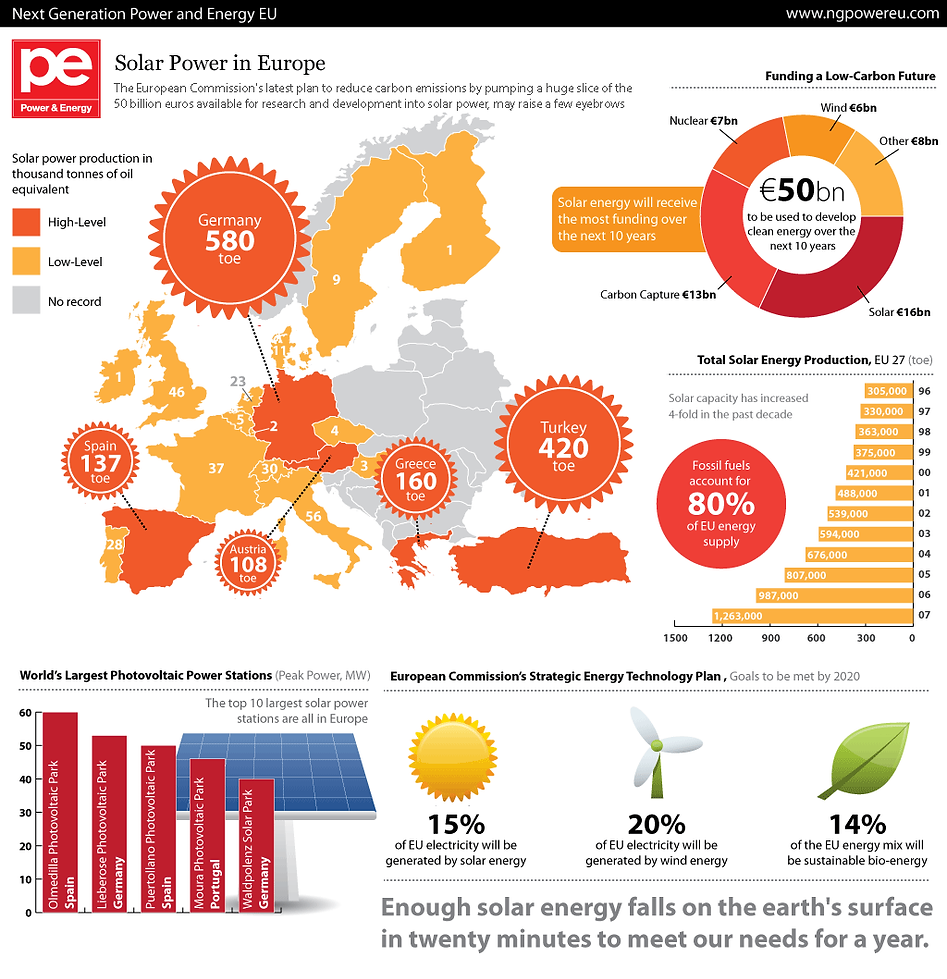
Solar Energy is the energy that is produced by the sun in the form of heat and light. It is one of the most renewable and readily available source of energy. The fact that it is available in plenty and free and does not belong to anybody makes it one of the most important of the non-conventional sources of energy. Solar energy has been used by people since ancient times by using simple magnifying glasses to concentrate the light of the sun into beams so hot they would cause wood to catch fire.
Mainly, Solar energy can be used to convert it into heat energy or it can be converted into electricity. Solar energy can be converted into electricity by means of solar thermal energy and photovoltaic. Through Solar Photovoltaic (SPV) cells, solar radiation gets converted into DC electricity directly. This form of energy can be used to power solar watches, calculators or traffic signals. They are often used in locations that are not connected to electricity grid. Solar heat energy can be used to heat water or space heating which means heating the space inside the building.
Solar energy can be broadly categorized as active or passive solar energy depending on how they are captured and utilized. In active solar energy special solar heating equipment is used to convert solar energy to heat energy whereas in passive solar energy the mechanical equipment is not present. Active solar include the use of mechanical equipment like photovoltaic cells, solar thermal collectors or pumps and fans to trap the solar energy. Passive solar technologies convert solar energy to heat energy without use of active mechanical systems. It is mainly the practice of using windows, walls, trees, building placement and other simple techniques to capture or deflect the sun for use. Passive solar heating is a great way to conserve energy and maximizing it’s utilization. An example of passive solar heating is what happens to your car on a hot summer day.
Environmental Impact
Although Solar energy is considered to be one of the cleanest and renewable sources of energy among the available sources but is has some environmental impacts too. Solar energy uses photovoltaic cells to produce solar power. However, manufacturing the photovoltaic cells to produces that energy requires silicon and produce some waste products. Inappropriate handling of these materials may lead to hazardous exposure to humans and the environment. Installing solar power plants may require large piece of land, which may impact existing ecosystems. Solar energy does not pollute the air when converted to electricity by solar panels. It is found in abundance and does not help in global warming.
Future Of Solar Energy
Solar technology is now poised to play a larger role in the future, thanks to new developments that could result in lower costs and improved efficiency. In fact, the solar PV industry aims to provide half of all new U.S. electricity generation by 2025. More and more architects are recognizing the value of active and passive solar and learning how to effectively incorporate it into building designs. Solar hot water systems can compete economically with conventional systems in some areas. Perhaps the future is here now. Shell has predicted that 50% of the world’s energy will come from renewable sources by 2040. In recent years manufacturing costs of photovoltaic cells has dropped by 3-5% per year while government subsidies have increased. While to some such facts about solar energy seem trivial, this makes solar energy an ever-more affordable energy source. In the next few years it is expected that millions of households in the world will be using solar energy as the trends in USA and Japan show. Aggressive financial incentives in Germany and Japan have made these countries global leaders in solar deployment for years.
conserve-energy-future.com
Solar Energy
Wind Energy
We have been harnessing the wind's energy for hundreds of years. From old Holland to farms in the United States, windmills have been used for pumping water or grinding grain. Today, the windmill's modern equivalent - a wind turbine - can use the wind's energy to generate electricity.
Wind turbines, like windmills, are mounted on a tower to capture the most energy. At 100 feet (30 meters) or more aboveground, they can take advantage of the faster and less turbulent wind. Turbines catch the wind's energy with their propeller-like blades. Usually, two or three blades are mounted on a shaft to form a rotor.
A blade acts much like an airplane wing. When the wind blows, a pocket of low-pressure air forms on the downwind side of the blade. The low-pressure air pocket then pulls the blade toward it, causing the rotor to turn. This is called lift. The force of the lift is actually much stronger than the wind's force against the front side of the blade, which is called drag. The combination of lift and drag causes the rotor to spin like a propeller, and the turning shaft spins a generator to make electricity.
Wind turbines can be used as stand-alone applications, or they can be connected to a utility power grid or even combined with a photovoltaic (solar cell) system. For utility-scale sources of wind energy, a large number of wind turbines are usually built close together to form awind plant. Several electricity providers today use wind plants to supply power to their customers.
Stand-alone wind turbines are typically used for water pumping or communications. However, homeowners, farmers, and ranchers in windy areas can also use wind turbines as a way to cut their electric bills.
Small wind systems also have potential as distributed energy resources. Distributed energy resources refer to a variety of small, modular power-generating technologies that can be combined to improve the operation of the electricity delivery system.
renewableenergyworld.com

Geothermal Energy
Geothermal energy is the heat from the Earth. It's clean and sustainable. Resources of geothermal energy range from the shallow ground to hot water and hot rock found a few miles beneath the Earth's surface, and down even deeper to the extremely high temperatures of molten rock called magma.
Almost everywhere, the shallow ground or upper 10 feet of the Earth's surface maintains a nearly constant temperature between 50° and 60°F (10° and 16°C). Geothermal heat pumps can tap into this resource to heat and cool buildings. A geothermal heat pump system consists of a heat pump, an air delivery system (ductwork), and a heat exchanger-a system of pipes buried in the shallow ground near the building. In the winter, the heat pump removes heat from the heat exchanger and pumps it into the indoor air delivery system. In the summer, the process is reversed, and the heat pump moves heat from the indoor air into the heat exchanger. The heat removed from the indoor air during the summer can also be used to provide a free source of hot water.
In the United States, most geothermal reservoirs of hot water are located in the western states, Alaska, and Hawaii. Wells can be drilled into underground reservoirs for the generation of electricity. Some geothermal power plants use the steam from a reservoir to power a turbine/generator, while others use the hot water to boil a working fluid that vaporizes and then turns a turbine. Hot water near the surface of Earth can be used directly for heat. Direct-use applications include heating buildings, growing plants in greenhouses, drying crops, heating water at fish farms, and several industrial processes such as pasteurizing milk.
Hot dry rock resources occur at depths of 3 to 5 miles everywhere beneath the Earth's surface and at lesser depths in certain areas. Access to these resources involves injecting cold water down one well, circulating it through hot fractured rock, and drawing off the heated water from another well. Currently, there are no commercial applications of this technology. Existing technology also does not yet allow recovery of heat directly from magma, the very deep and most powerful resource of geothermal energy.
Many technologies have been developed to take advantage of geothermal energy - the heat from the earth. NREL performs research to develop and advance technologies for the following geothermal applications:
-
Geothermal Energy Technologies:
-
Geothermal Electricity Production Generating electricity from the earth's heat.
-
Geothermal Direct Use Producing heat directly from hot water within the earth.
-
Geothermal Heat Pumps Using the shallow ground to heat and cool buildings.
renewableenergyworld.com


Say stop to holocaust against animals, environment and Earth